Indian Folk Culture: A Tapestry of Diversity

Celebrating the Essence of Unity: The Statue of Unity and Sardar Patel’s Memorial
Statue of Unity and Sardar Vallabhbhai Patel’s Memorial Heritage: A Journey into India’s Unity, Culture, and Collective Happiness** part 2
Gajanan L. Bhonde
12/16/20258 min read


The Statue of Unity: A Beacon of Togetherness
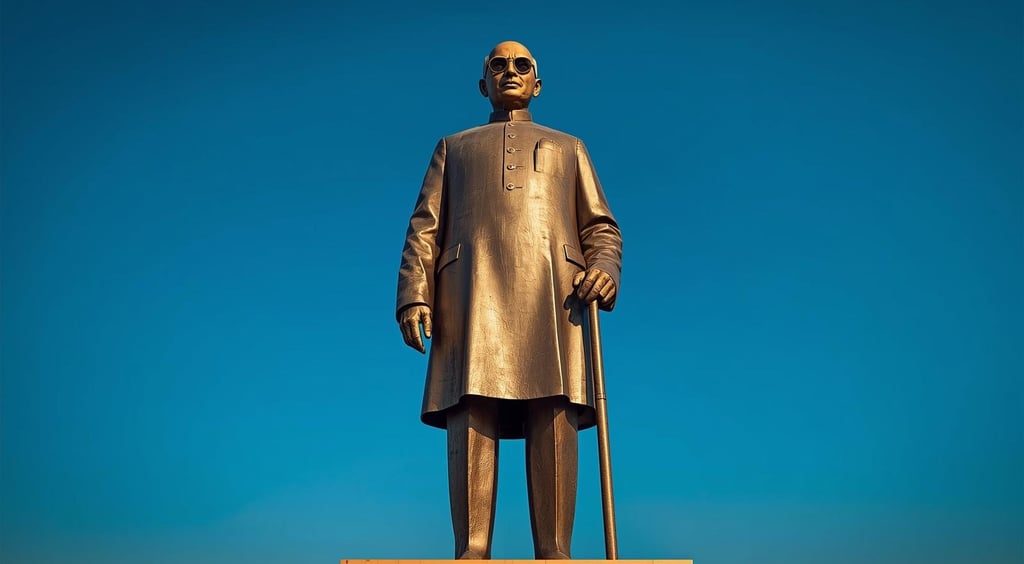
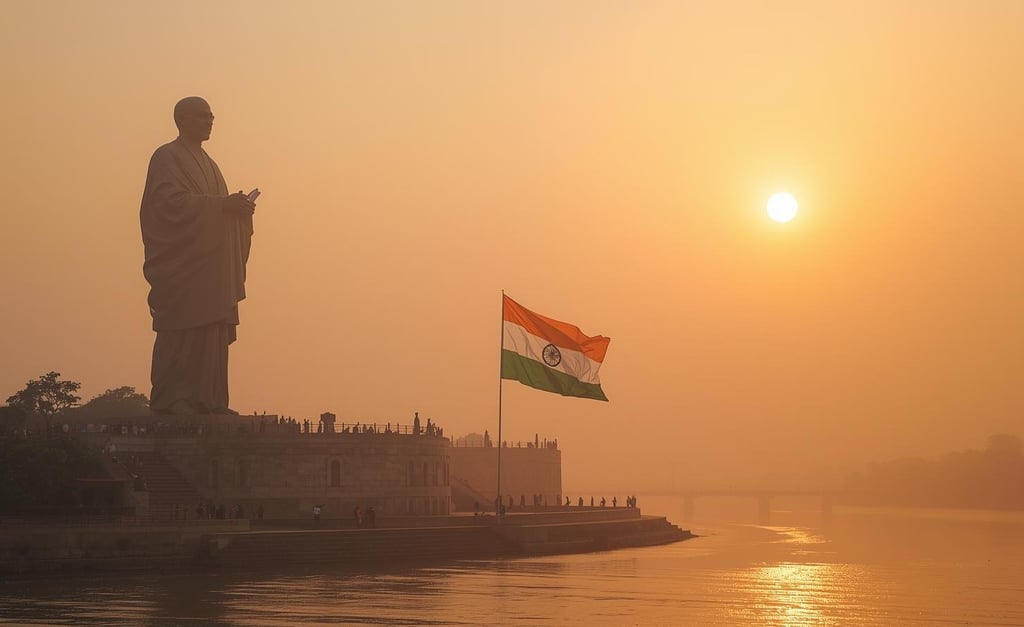
The Statue of Unity, standing at a towering height of 182 meters, is not just an architectural marvel but a powerful symbol of India’s unity. Erected in honor of Sardar Vallabhbhai Patel, the first Deputy Prime Minister, this colossal statue signifies the importance of togetherness in a nation characterized by cultural diversity. As visitors approach this monumental structure, they are greeted with a profound reminder of how India's strength lies in its unity, echoing the sentiment that when India stands united, India smiles.
Sardar Patel’s Memorial: A Testament to Discipline and Culture
Adjacent to the Statue of Unity is Sardar Patel's Memorial, a place that encapsulates the essence of discipline, culture, and hope. This memorial serves not only as a tribute to Patel's legacy but also emphasizes the teachings he imparted regarding national integrity. As tourists explore the intricate designs and captivating narratives behind the memorial, they are invited to reflect on the blessings of India’s cultural diversity. Each artifact and exhibit speaks volumes about how unity can foster deeper connections among the myriad communities that thrive within the country.
The Significance of Unity in National Happiness
Visiting the Statue of Unity and Sardar Patel’s Memorial transcends the concept of mere tourism; it becomes a celebration of India’s soul. In this space, citizens and travellers alike partake in an experience that reinforces the belief that national happiness grows when unity is protected. These destinations highlight the collective aspiration for a harmonious society, reminding everyone that through collaboration and mutual respect, a brighter future can be achieved. The echoes of history resonate within these grounds, instilling hope for generations to come.
In conclusion, the Statue of Unity and Sardar Patel’s Memorial stand as powerful reminders of the importance of unity in India. They encapsulate the vivid tapestry of our nation's heritage and the promise of a united future. As we gather at these significant sites, we not only pay homage to our past but also celebrate the enduring spirit of cooperation that binds us all together. The joy and pride emanating from these monuments serve as a clarion call for unity, urging us to cherish our diversity while collectively striving for greatness.
**Statue of Unity and Sardar Vallabhbhai Patel’s Memorial Heritage:
A Journey into India’s Unity, Culture, and Collective Happiness**
Section 1: Introduction – When a Nation Celebrates Its Unity
India’s happiness does not come only from festivals or prosperity; it comes from unity amid diversity. The Statue of Unity, dedicated to Sardar Vallabhbhai Patel, stands not merely as a monument of stone and steel, but as a living symbol of Indian cultural harmony, national integration, and collective pride.
Along with the Statue of Unity, various memorial homes and institutions associated with Sardar Patel across India form a heritage network that reflects:
India’s struggle for unity
Administrative wisdom
Cultural coexistence
Democratic stability
Visiting these places is not just tourism—it is a journey of national consciousness and happiness.
Section 2: Sardar Vallabhbhai Patel – The Soul Behind the Symbol
Sardar Patel unified over 560 princely states into one nation. Without his decisive leadership:
India could have fragmented
Democracy could have weakened
Cultural unity could have collapsed
The Statue of Unity and Patel memorials are reminders that India’s happiness is protected by unity and discipline, not chaos.
Patel’s life teaches:
Unity is strength
Administration is service
Culture survives through discipline
Section 3: The Statue of Unity – Location, Vision, and Meaning
Location
Kevadia, Narmada District, Gujarat
On the banks of the Narmada River
Facing the Sardar Sarovar Dam
Height and Global Significance
Height: 182 meters (597 feet)
Tallest statue in the world
Symbolizes India’s global confidence
Vision
The Statue of Unity was envisioned as:
A tribute to national integration
A symbol of Indian resilience
A cultural landmark for future generations
It represents one nation, one destiny, and many cultures.
Section 4: Architectural and Cultural Features of the Statue of Unity
Engineering Excellence
Designed to withstand earthquakes and strong winds
Built using Indian labor and technology
Integrated with modern sustainability principles
Cultural Symbolism
Patel’s firm posture → determination
Traditional attire → cultural roots
Forward gaze → future vision
Visitor Attractions
Observation Deck
Museum & Exhibition Hall
Audio-visual galleries
Valley of Flowers
Riverfront walks
Every element reflects India’s unity through diversity.
Section 5: Statue of Unity as a National Tourism Hub
The Statue of Unity has transformed Kevadia into a world-class tourism destination.
Major Attractions Around
Valley of Flowers
Jungle Safari
Ekta Nagar
Narmada Aarti
River rafting & eco-tourism
Impact on Happiness and Economy
Employment generation
Tribal development
Cultural pride
Local handicrafts promotion
Tourism here is not commercial alone—it is cultural celebration.
Section 6: How Tourists Can Reach the Statue of Unity (Complete Guide)
By Air
Nearest airport: Vadodara (≈90 km)
International access via Ahmedabad
By Train
Kevadia Railway Station (direct connectivity)
Trains from Delhi, Mumbai, Ahmedabad
By Road
Well-connected highways
State transport & private buses available
Local Transport
Electric buses
Bicycle tracks
Eco-friendly mobility
The journey itself reflects India’s modern yet sustainable tourism vision.
Section 7: Sardar Patel’s Memorial Homes Across India
1. Karamsad, Gujarat (Birthplace)
Patel’s ancestral home
Simple lifestyle preserved
Reflects humility and discipline
2. Ahmedabad – Sardar Patel National Memorial
Exhibitions, letters, speeches
Freedom movement artifacts
Educational center for youth
3. Mumbai Associations
Patel’s administrative legacy
Contribution to national governance
These places form a spiritual map of Indian unity.
Section 8: Memorials as Symbols of Indian Cultural Unity
Each Patel memorial represents:
Simplicity over luxury
Discipline over disorder
Unity over division
Visitors experience:
Emotional connection with history
Pride in democratic values
Respect for cultural diversity
These places teach that Indian happiness is rooted in harmony, not uniformity.
section 9: Statue of Unity and Youth Inspiration
For Indian youth, the Statue of Unity is:
A leadership classroom
A lesson in discipline
A reminder of national responsibility
Youth learn:
Nation-building requires sacrifice
Culture survives through unity
Democracy needs strong institutions
This inspiration builds positive national happiness.
Section 10: Conclusion – Celebrating the Happiness of India Through Unity
The Statue of Unity and Sardar Patel’s memorial places are not silent monuments—they speak the language of unity, discipline, culture, and hope.
They remind us that:
India’s strength lies in togetherness
Cultural diversity is a blessing
National happiness grows when unity is protected
Visiting these places is not just tourism—it is celebrating the soul of India.
“When India stands united, India smiles.”
Final Message
The Statue of Unity stands tall not just in height, but in meaning. Along with Patel’s memorial heritage, it forms a cultural pilgrimage of happiness, unity, and national pride.
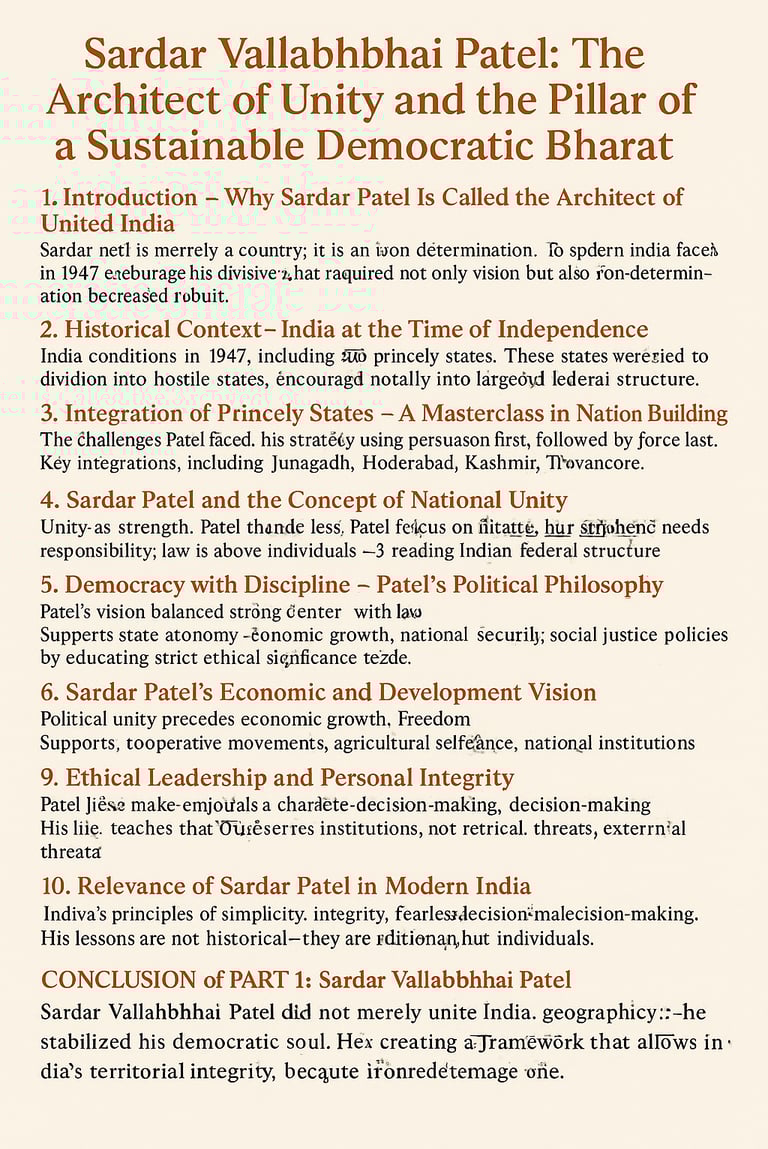
Sardar Vallabhbhai Patel: The Architect of Unity and the Pillar of a Sustainable Democratic Bharat
Section 1: Introduction – Why Sardar Patel Is Called the Architect of United India
India is not merely a country; it is a civilizational experiment of unity in diversity. Languages, religions, cultures, castes, and geographies coexist within one constitutional framework. Holding such a vast and diverse society together required not only vision but also iron determination. That determination was embodied in Sardar Vallabhbhai Patel, rightly remembered as the “Iron Man of India.”
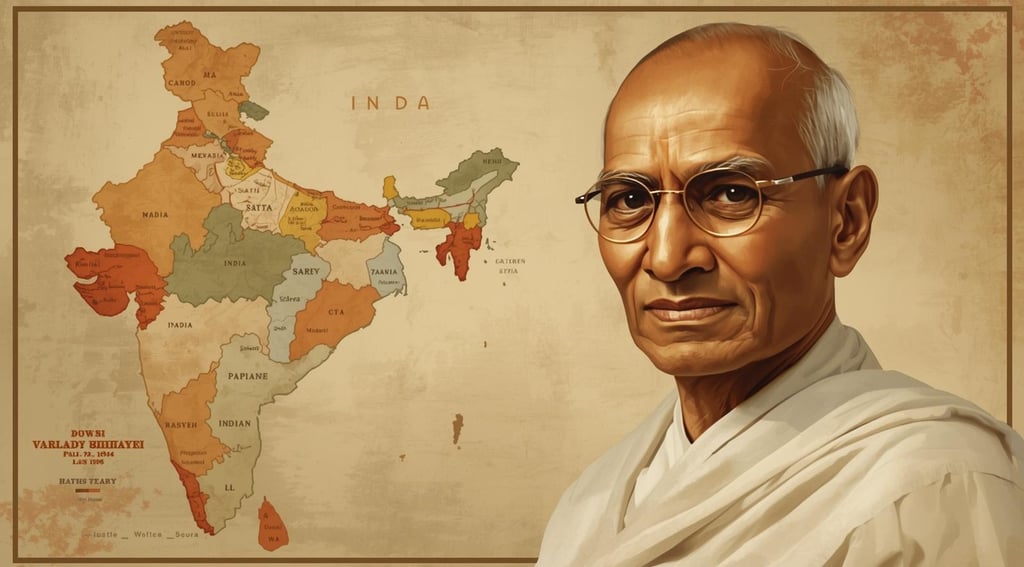
Sardar Patel’s contribution to Indian independence is often overshadowed by louder political narratives, yet modern India’s territorial integrity, administrative discipline, and federal structure stand on the foundation he laid. Without Patel’s decisive leadership during the fragile years of independence, India could have fragmented into dozens of hostile states, weakened democratically and geopolitically.
His role was not emotional nationalism but practical nation-building. He believed that freedom without unity is chaos, and democracy without discipline becomes disorder. Patel transformed a post-colonial, divided land into a unified republic, ensuring that India could survive as a sustainable, advanced democratic nation.
Section 2: Historical Context – India at the Time of Independence
To understand Sardar Patel’s greatness, we must understand the crisis India faced in 1947.
At independence:
India had 565+ princely states
These states were not legally bound to join India
Some rulers wanted independence
Some wanted to join Pakistan
British authority had withdrawn abruptly
Communal violence had weakened administrative control
India risked becoming:
A loose confederation
A balkanized subcontinent
A weak democracy vulnerable to foreign interference
This was not merely a political problem—it was a civilizational emergency.
Sardar Patel, as Deputy Prime Minister and Home Minister, took responsibility for internal stability, integration, law and order, and administrative continuity. While others debated ideology, Patel acted.
Section 3: Integration of Princely States – A Masterclass in Nation Building
3.1 The Challenge
The princely states varied widely:
Some were tiny
Some were larger than European countries
Many had private armies
Most rulers feared loss of power
If even a few major states remained independent, India’s democracy would have collapsed.
3.2 Patel’s Strategy: Persuasion First, Force Last
Patel adopted a three-fold strategy:
Diplomatic persuasion
Administrative assurance
Military action only when unavoidable
He promised:
Respect to rulers
Privy purses (temporary financial security)
Dignified integration
This humane yet firm approach prevented unnecessary bloodshed.
3.3 Key Integrations
Junagadh – decisive action
Hyderabad – Operation Polo
Kashmir – constitutional accession
Travancore, Bhopal, Jodhpur – diplomatic success
Within less than three years, Patel unified India—a task unmatched in modern political history.
Section 4: Sardar Patel and the Concept of National Unity
For Patel, unity was not uniformity.
He believed:
Diversity must be preserved
Sovereignty must be shared
Authority must be centralized where necessary
Culture must remain local
This balance created the Indian federal structure.
Unity as Strength
Patel understood that:
Fragmented nations fail
Strong democracies require stable borders
Political freedom must be backed by territorial integrity
His idea of unity was constitutional, not emotional. This is why India, unlike many newly independent nations, did not collapse into civil war.
Section 5: Democracy with Discipline – Patel’s Political Philosophy
Unlike populist leaders, Patel believed:
Democracy is not crowd rule
Freedom needs responsibility
Law is above individuals
He warned:
“A democracy without discipline is like a body without a backbone.”
This philosophy influenced:
Law enforcement
Civil services
Internal security policy
Patel vs Political Romanticism
While others spoke of idealism, Patel focused on:
Institutions
Systems
Continuity
This made Indian democracy resilient, not fragile.
Section 6: Contribution to Indian Administrative System (IAS, IPS)
One of Patel’s most underrated contributions is the All India Services.
Why It Mattered
After independence:
Provinces were unstable
Political interference was high
Administrative vacuum existed
Patel insisted on:
Strong, neutral civil services
Officers loyal to the Constitution, not parties
He famously said:
“You will not have a united India if you do not have a good All-India Service.”
Today, IAS and IPS remain the spinal cord of Indian governance.
Section 7: Federalism and Sustainable Governance
Patel’s vision balanced:
Strong Center
Autonomous States
This balance allowed:
Economic planning
National security
Social justice policies
He rejected extreme decentralization because:
India was newly independent
External threats were high
Internal divisions were deep
This pragmatic federalism allowed India to evolve peacefully into a mature democracy.
Section 8: Sardar Patel’s Economic and Development Vision
Though not an economist by training, Patel believed:
Political unity precedes economic growth
Stability attracts development
Infrastructure requires centralized planning
He supported:
Cooperative movements
Agricultural self-reliance
National institutions
His Gujarat roots shaped his belief in grassroots economic strength.
Section 9: Ethical Leadership and Personal Integrity
Patel’s life reflected:
Simplicity
Integrity
Fearless decision-making
He rejected personality cults and believed:
Leaders must serve institutions
Power must be temporary
Legacy must be national, not personal
This ethical foundation strengthened India’s democratic culture.
Section 10: Relevance of Sardar Patel in Modern India
Today’s India faces:
Polarization
Regionalism
Identity politics
External threats
Patel’s principles offer solutions:
Unity over division
Law over chaos
Institutions over individuals
Nation before politics
His life teaches that true nationalism is responsibility, not rhetoric.